Customer Background
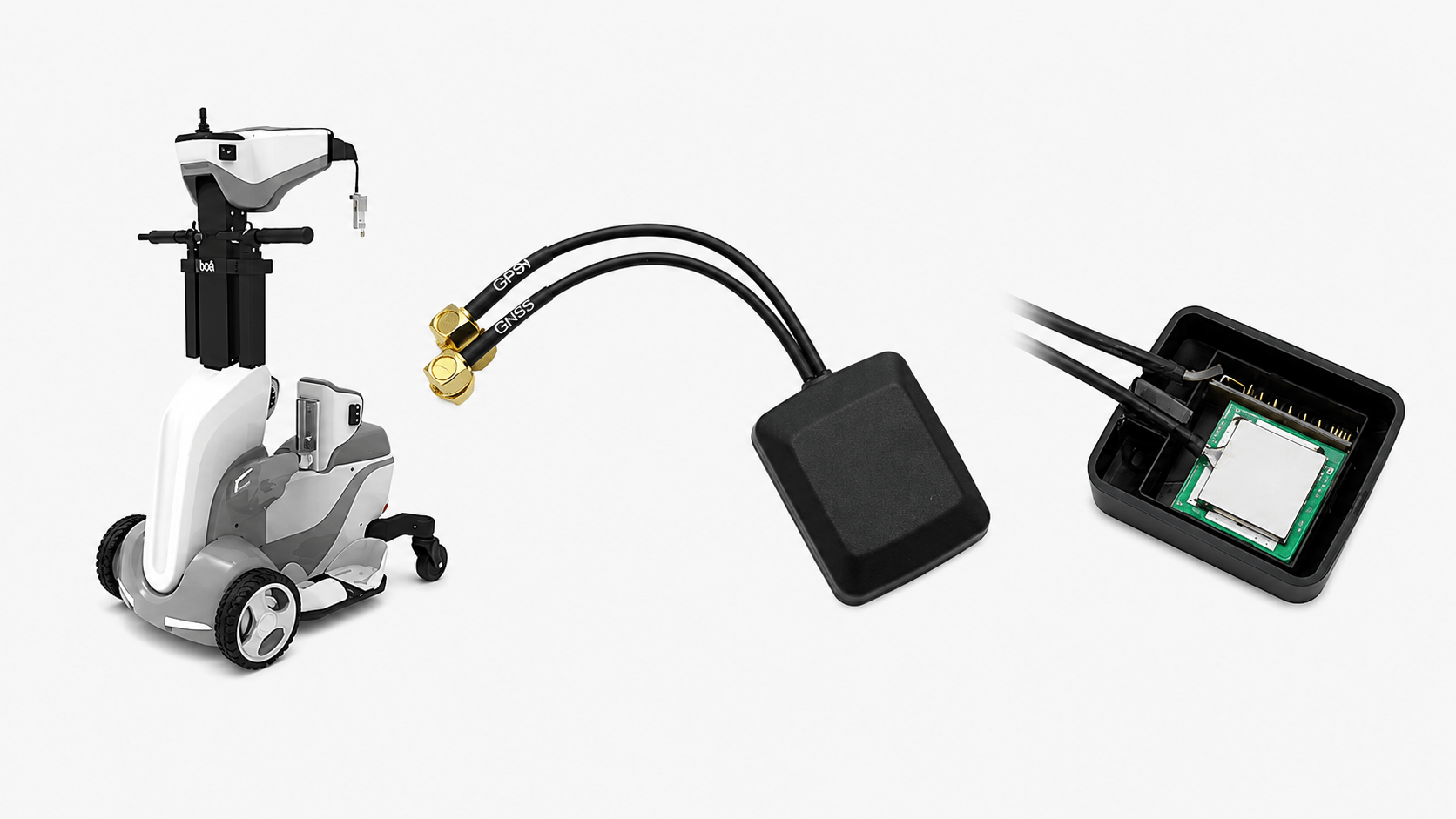
Shanghai Bangbang Intelligent Robot focuses on developing intelligent assistive products designed to help elderly people and people with disabilities improve mobility, safety, and quality of life.
The company integrates independent research and development, manufacturing, and sales of intelligent assistive products. Through intelligent technologies, Bangbang Intelligent Robot continues to develop solutions for future healthcare and elderly-care applications.
For one of its connected healthcare products, the customer required a compact antenna solution integrating GPS, BeiDou, and GSM communication within a single enclosure.
Antenna Performance Requirements
The customer required the GPS + BeiDou positioning antenna and GSM communication antenna to be integrated into one compact antenna structure.
The main requirements included:
- GPS positioning support
- BeiDou positioning support
- GSM wireless communication
- GPS/BeiDou and GSM antennas integrated into one enclosure
- Positioning accuracy within approximately 10 m
- Stable wireless communication
- Compact dimensions suitable for the limited internal installation space
The antenna system needed to provide both reliable positioning and wireless communication while minimizing mutual interference between the different RF systems.
The Challenge
For assistive and connected healthcare products, reliable positioning and communication can play an important role in real-time monitoring and emergency assistance.
If positioning accuracy is insufficient, medical or care personnel may require more time to locate the user.
At the same time, unstable wireless communication may affect the ability of the user to quickly send an SOS request for help.
For this reason, both positioning accuracy and communication stability were important requirements for the project.
A reliable 24/7 connected monitoring system can provide more useful information about a user’s location, activity, and care status, supporting more informed healthcare and assistance decisions.
Achieving these functions within a compact terminal device, however, created a significant antenna engineering challenge.
Problem Description
The customer provided an antenna installation space of only:
50 × 40 mm
Both the GPS/BeiDou positioning antenna and the GSM communication antenna had to be installed within this limited area.
Because multiple antennas operate in such close proximity, mutual RF interference becomes more difficult to control.
The limited space therefore created significant challenges in:
- Antenna placement
- RF isolation
- Grounding
- GPS sensitivity
- GSM performance
- Mutual interference control
The engineering team’s ability to optimize isolation between the positioning antenna and the GSM antenna became a critical part of the final antenna performance.
Cowin Antenna Solution
1. Developing a More Accurate GPS/BeiDou Antenna Solution
Bangbang Intelligent recognized that GPS antenna performance was critical to achieving the required positioning accuracy of within approximately 10 m.
After evaluating different antenna products and suppliers, the company selected Cowin Antenna to develop the customized combined antenna solution.
The objective was to provide reliable positioning performance while integrating the positioning and communication antennas into the customer’s limited available space.
2. Using the PCB as the Antenna Ground Plane
One of the key requirements of the Cowin antenna solution was to use the product circuit board as a suitable ground plane.
This helped reduce the influence of other RF signals on the positioning antenna and minimize interference that could negatively affect GPS positioning accuracy.
The grounding structure was therefore considered as part of the complete antenna system rather than treating the GPS antenna as an independent component.
3. GPS/BeiDou Active Antenna Optimization
The positioning antenna was designed around an 18 × 18 mm ceramic antenna element.
The antenna system incorporated:
- Two LNA amplifiers
- Front-end SAW filters
- 18 × 18 mm ceramic antenna element
The SAW filtering helped significantly reduce unwanted out-of-band noise.
Combined with the amplifier design, the active positioning antenna achieved an effective gain of approximately:
28–30 dB
This helped improve the receiving performance required for accurate GPS/BeiDou positioning.
4. GSM Antenna Design for Limited Installation Space
Based on the available installation space, Cowin engineers selected a spiral-loaded antenna structure to achieve the required GSM resonance characteristics within the compact product dimensions.
The GSM antenna covered the following frequency ranges:
- 800–920 MHz
- 1710–1900 MHz
The final GSM antenna achieved:
- Peak gain: up to 3.3 dBi
- Antenna efficiency: up to 68%
The spiral-loaded structure helped achieve the required low-frequency performance while keeping the antenna dimensions compatible with the customer’s limited installation space.
5. Improving Isolation Between the Two Antennas
Because the GPS/BeiDou and GSM antennas were installed very close to each other, reducing mutual interference was one of the most important challenges in the project.
Cowin engineers used a high-density epoxy glass-fiber laminate to provide physical and RF isolation between the two antenna sections.
After optimization, isolation between the antennas reached up to:
25 dB
This significantly reduced mutual signal interference between the positioning antenna and GSM antenna and helped maintain stable performance for both systems.
6. Final Combined Antenna Dimensions
After integrating and optimizing the GPS/BeiDou and GSM antenna structures, the final combined antenna dimensions were:
45 × 35 mm
This allowed the complete antenna system to fit within the customer’s original 50 × 40 mm available installation space.
The final solution integrated:
- GPS positioning
- BeiDou positioning
- GSM communication
- Active positioning amplification
- RF filtering
- Antenna isolation
into one compact antenna assembly.
The completed antenna solution passed the customer’s actual product testing and acceptance.
Antenna Performance Results
After antenna design, RF optimization, isolation tuning, and product-level testing, the final combined antenna achieved:
- Positioning systems: GPS + BeiDou
- Communication: GSM
- Target positioning accuracy: within approximately 10 m
- GPS/BeiDou ceramic element: 18 × 18 mm
- Active positioning antenna gain: approximately 28–30 dB
- GSM frequency range: 800–920 MHz / 1710–1900 MHz
- GSM peak gain: up to 3.3 dBi
- GSM antenna efficiency: up to 68%
- Isolation between antenna sections: up to 25 dB
- Final combined antenna size: 45 × 35 mm
The final antenna solution met the customer’s requirements for compact integration, positioning performance, GSM communication, and antenna isolation.
Project Results
The customized GPS/BeiDou + GSM combined antenna was successfully integrated into the customer’s connected healthcare product and passed actual product testing and acceptance by Bangbang Intelligent Robot.
By integrating positioning and communication functions within a compact 45 × 35 mm antenna structure, the solution addressed the challenge of installing multiple RF systems within the customer’s limited 50 × 40 mm space.
The combination of active GPS/BeiDou amplification, SAW filtering, GSM antenna optimization, and up to 25 dB antenna isolation helped provide a stable RF foundation for positioning, communication, and connected healthcare applications.
Economic Benefits
The customer successfully launched the product to market using the customized antenna solution.
According to the project information provided, cumulative product sales reached approximately 20,000 units.
The project demonstrated how antenna integration, RF isolation, filtering, amplification, and compact structural design can be optimized together to support positioning and wireless communication within space-constrained connected healthcare products.