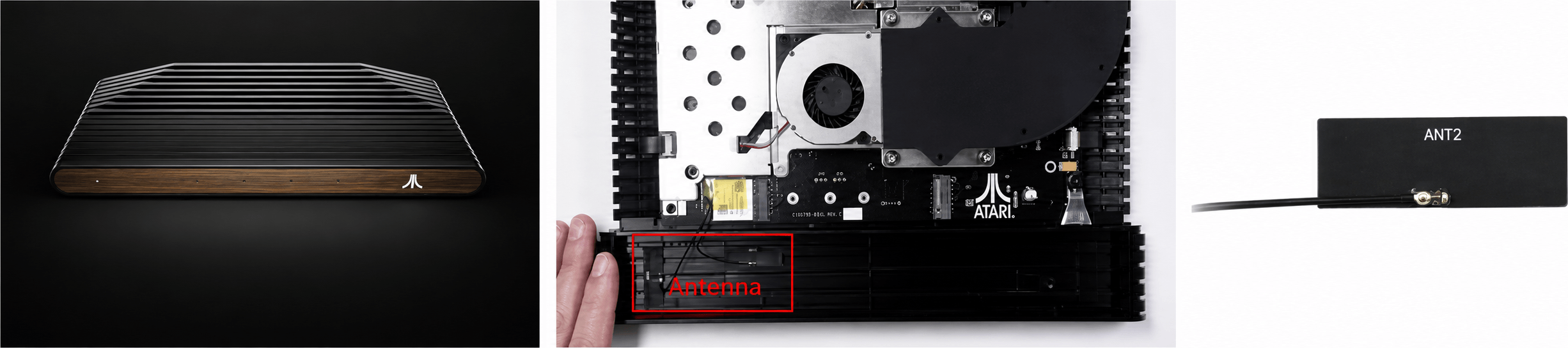
Customer Background
Atari was founded in the United States in 1972 and became one of the early pioneers of arcade games, home video game consoles, and home computers. The brand has played an important role in the development of the global video game industry.
The Atari VCS involved in this project was manufactured by Feixu Electronics (Suzhou), an electronics manufacturing services provider with global operations.
Cowin Antenna was selected to support the Atari VCS project with a customized wireless antenna solution.
Unlike projects where antenna integration is considered only after the product structure has already been finalized, antenna development for this project began during the early stage of terminal product design. This allowed the antenna solution to be developed together with the product structure and wireless communication system.
Antenna Performance Requirements
The Atari VCS required reliable indoor Wi-Fi communication with a focus on coverage, signal stability, and resistance to interference.
The main performance requirements included:
- Low signal attenuation during transmission
- Longer wireless communication distance
- Reduced interference
- Stable signal transmission and reception
- Indoor wireless coverage of approximately 50 m in diameter
- Antenna development integrated into the early stage of terminal product design
Achieving longer communication distance, low propagation loss, reduced interference, and stable wireless performance at the same time created a significant challenge for the antenna engineering team.
Challenge
Indoor Wi-Fi performance is affected by many factors, including operating frequency, surrounding wireless devices, product structure, antenna position, and the actual RF environment inside the terminal.
The customer wanted to maintain the longer transmission characteristics of the lower-frequency Wi-Fi band while also reducing interference and improving connection stability.
Meeting these requirements within the limited internal space of the Atari VCS significantly increased the complexity of the antenna design.
Problem Description
2.4 GHz Wi-Fi Band
The 2.4 GHz Wi-Fi band operates at a relatively lower frequency and generally provides lower propagation loss and a longer effective transmission distance.
Its main advantages include:
- Better propagation characteristics
- Lower signal attenuation
- Longer wireless transmission distance
However, the 2.4 GHz band is also widely used by many wireless devices.
Because multiple devices share the same frequency spectrum, the band can be more susceptible to congestion and interference in complex wireless environments.
5 GHz Wi-Fi Band
The 5 GHz Wi-Fi band provides more available spectrum and generally experiences less interference from common 2.4 GHz devices.
Its main advantages include:
- Wider available frequency spectrum
- Lower interference in many environments
- Stable wireless communication performance
However, because 5 GHz operates at a higher frequency, the signal generally experiences greater attenuation during propagation.
Compared with 2.4 GHz, the 5 GHz band typically provides a shorter effective coverage range and weaker penetration through obstacles.
The engineering challenge was therefore to combine the advantages of both bands within one antenna system.
Cowin Antenna Solution
1. Upgrade from Single-Band to Dual-Band Wi-Fi
Cowin engineers discussed the wireless requirements with the Atari product design team and reached a consensus on the antenna architecture.
The original 2.4 GHz single-band Wi-Fi antenna was upgraded to a:
2.4 GHz / 5 GHz dual-band Wi-Fi antenna
This approach combined the longer-range characteristics of the 2.4 GHz band with the lower-interference and wider-spectrum characteristics of the 5 GHz band.
The dual-band design helped overcome the limitations of relying on either a single lower-frequency band or a single higher-frequency band.
2. Upgrade the Wireless Module
To support the new dual-band antenna architecture, the terminal product also required an upgrade to its wireless transmitting and receiving module.
The original single-band 2.4 GHz Wi-Fi module was replaced with a 2.4 GHz / 5 GHz dual-band Wi-Fi module.
This ensured that the antenna and wireless communication module could operate together as a complete dual-band system.
3. Analyze the Complete Product Structure
To support antenna development, the customer provided the engineering materials required for product-level RF analysis.
These included:
- Original product prototype
- Product enclosure
- Finished PCB assembly
- Circuit diagrams
- Mechanical assembly drawings
- Plastic enclosure material information
These materials allowed Cowin engineers to understand the actual environment in which the antenna would operate.
Instead of designing the antenna independently, the antenna could therefore be optimized according to the real terminal structure.
4. Antenna Simulation and Design
Based on the product information provided by the customer, Cowin engineers carried out antenna simulation and design according to the actual RF environment inside the Atari VCS.
The engineering team evaluated factors such as:
- Available installation space
- Antenna position
- PCB structure
- Product enclosure
- Enclosure materials
- Surrounding electronic components
- Dual-band RF performance
- Signal transmission stability
This product-level development process allowed the antenna to be optimized according to the actual operating environment.
5. Finalize the Antenna Dimensions
After the antenna installation position was determined and the structural engineering team confirmed the available space, the final antenna dimensions were defined as:
31.5 × 10.7 mm
The compact flexible antenna was designed to fit within the limited available space while still supporting the required 2.4 GHz / 5 GHz dual-band Wi-Fi performance.
6. Rapid Antenna Prototype Development
Cowin engineers used rapid antenna prototyping equipment to shorten the development and sample verification cycle.
Through rapid prototype manufacturing, tuning, and testing, the engineering team successfully completed and delivered the antenna samples within approximately one week.
The final antenna achieved:
- Frequency bands: 2.4 GHz / 5 GHz Wi-Fi
- Antenna size: 31.5 × 10.7 mm
- Peak gain: up to 5.8 dBi
- Antenna efficiency: up to 77%
- Stable dual-band wireless communication
- Reduced interference
- Reliable signal transmission and reception
The final antenna solution met the customer’s wireless communication and product integration requirements.
Project Results
The customized dual-band flexible Wi-Fi antenna was successfully integrated into the Atari VCS.
By upgrading the original single-band 2.4 GHz solution to a 2.4 GHz / 5 GHz dual-band Wi-Fi architecture, the product was able to combine the different advantages of the two frequency bands and achieve more balanced wireless communication performance.
The project also demonstrated the importance of developing the antenna together with the terminal product from the early design stage.
By considering the antenna, wireless module, PCB, enclosure, installation position, and internal RF environment together, potential wireless performance issues could be addressed before the product entered mass production.
Economic Benefits
The customer successfully launched the product to market.
According to the project information provided, cumulative sales reached approximately 100,000 units.
The successful commercialization of the product demonstrated that the customized antenna solution was able to meet both the customer’s technical requirements and product integration needs.