Customer Background
Shanghai Loostone Technology is a high-tech enterprise specializing in the design and development of intelligent audio and video products. Headquartered in Shanghai, the company works with mainstream brands including Alibaba, Baidu, Huawei, Xiaomi, Skyworth, TCL, and Jipin, and has established a strong position in its vertical market.
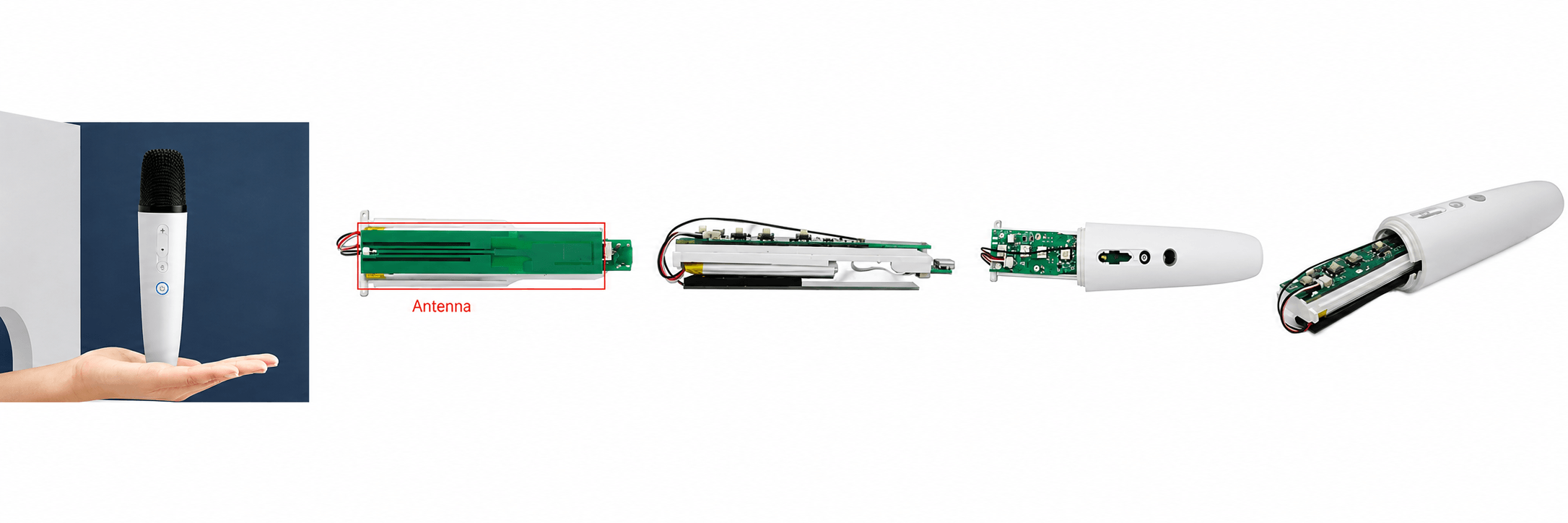
For one of its Q1 microphone products, the customer required a more reliable low-frequency wireless antenna solution to improve signal stability and communication performance in home entertainment and KTV environments.
After communicating with and evaluating multiple antenna suppliers, the customer ultimately selected Cowin Antenna to undertake the antenna research and development for the Q1 product.
Business Requirements
The microphone product operates within the 650–700 MHz frequency range and is mainly intended for use in homes and KTV entertainment venues.
The key wireless performance requirement was clear:
- Operating frequency: 650–700 MHz
- Application: Home and KTV entertainment
- Target communication range: Within a 10 m radius
- Performance requirement: No signal disconnection or noticeable noise within the specified range
The customer therefore needed an antenna solution capable of providing more stable wireless communication and stronger resistance to interference.
Problem Description
The original antenna was designed directly onto the product’s main PCB as an onboard antenna.
However, during actual use, this antenna solution could not meet the customer’s required communication range and signal stability.
Testing showed that the original onboard antenna could maintain acceptable signal performance only within a radius of approximately 2 meters, far below the customer’s target of 10 meters.
To solve the problem, the customer communicated and discussed the project with several antenna companies.
After evaluating different options, Cowin Antenna was selected to take responsibility for the antenna development of the Q1 microphone product.
The Challenge
For wireless microphone applications, signal stability and resistance to interference are critical to reliable wireless communication.
The challenge becomes greater in environments where many electronic devices are operating simultaneously or where there are large numbers of people, such as KTV venues and other entertainment environments.
In these complex RF environments, wireless signals can be subject to significant interference.
For a low-frequency antenna operating at 650–700 MHz, achieving stable performance normally requires sufficient antenna space and an adequate grounding area.
However, the internal structure of the microphone provided very limited installation space:
- Internal length: 100 mm
- Internal diameter: 25 mm
Designing an antenna that could provide the required signal stability, communication range, and anti-interference performance within this compact cylindrical space presented a significant challenge for the engineering team.
Cowin Antenna Solution
1. Antenna Installation Had to Match the Product Assembly Process
The product’s main PCB was first installed into a motherboard bracket and then pushed into the microphone housing during assembly.
Because of this manufacturing structure, the antenna needed to be connected to either the main PCB or the motherboard bracket before the entire assembly was inserted into the housing.
Considering the requirements of subsequent mass production, installing or attaching the antenna inside the housing in advance was ruled out.
The antenna therefore had to be designed around the existing motherboard and bracket structure while remaining suitable for efficient mass-production assembly.
2. Limited Installation Position Due to Functional Components
One side of the motherboard bracket contained functional buttons, which meant that the antenna could not be installed on that side.
The only available installation position was therefore on the opposite side.
However, this side was occupied by a large-capacity battery.
The battery had a significant impact on antenna performance, creating an additional challenge for antenna placement, tuning, and RF optimization.
Cowin’s engineers therefore needed to find a way to install the antenna close to the battery while minimizing its negative influence on antenna performance.
3. Creating Isolation Between the Antenna and Battery
Through close cooperation and analysis between Cowin’s structural engineers and RF engineers, the team decided to add 5 mm-thick isolation foam to the antenna PCB.
The purpose of this design was to create a reasonable separation distance between the antenna and the battery.
By increasing this spacing, the engineers were able to reduce the battery’s influence on antenna performance as much as possible while still working within the limited internal space of the microphone.
This provided the antenna with a more suitable RF operating environment without requiring major changes to the original product structure.
4. Antenna Size Determined by the Available Internal Space
After the installation position was confirmed, the available space defined by the structural design determined the final antenna dimensions.
The antenna size was therefore defined as:
100 × 17 mm
This allowed the antenna to make effective use of the available internal length while remaining compatible with the narrow internal structure of the microphone.
5. Five Prototype Iterations to Optimize Performance
To shorten the development cycle, Cowin engineers used rapid PCB antenna prototyping equipment to manufacture and test antenna samples.
A total of five rigid PCB antenna prototype iterations were completed during the development process.
After repeated testing, tuning, and structural optimization, the engineering team successfully developed a double-sided rigid PCB antenna with final dimensions of:
100 × 17 × 1 mm
The final antenna achieved:
- Operating frequency: 650–700 MHz
- Peak gain: up to 4.8 dBi
- Antenna efficiency: up to 44%
- Final dimensions: 100 × 17 × 1 mm
- Double-sided PCB antenna structure
- Improved grounding area
- Improved resistance to interference
- Improved long-distance wireless transmission performance
Increasing the effective grounding area helped improve the antenna’s resistance to interference and supported more stable signal transmission over longer distances.
The final antenna solution successfully addressed the performance limitations of the original onboard antenna.
Project Results
The optimized low-frequency rigid PCB antenna was successfully integrated into the customer’s microphone product.
Compared with the original onboard antenna solution, which could only meet the required signal performance within approximately a 2 m radius, the newly developed antenna solution was designed to meet the customer’s requirement for stable wireless communication within a 10 m radius in home and KTV entertainment environments.
The final design also met the structural and assembly requirements of the microphone while improving wireless signal stability and resistance to interference.
Economic Benefits
The customer successfully launched the product to market using the optimized antenna solution.
According to the project information provided, cumulative product sales reached approximately 500,000 units, and the product continued to achieve strong market sales.
The project demonstrated how antenna structure, grounding area, installation position, battery isolation, and product assembly requirements can all influence the final wireless performance of a compact microphone product.
By optimizing these factors together, Cowin Antenna was able to develop a practical antenna solution that met both the customer’s RF performance requirements and mass-production needs.
Custom PCB Antenna Development for Wireless Microphones
For compact wireless products, antenna performance cannot be evaluated based only on frequency specifications.
Factors such as the product enclosure, PCB structure, grounding area, battery position, nearby electronic components, installation space, and assembly method can all significantly influence final RF performance.
Cowin Antenna provides customized antenna development and optimization services for wireless products, including:
- Low-frequency PCB antennas
- Rigid PCB antennas
- Internal embedded antennas
- Wireless microphone antennas
- Customized RF antenna solutions
- Antenna simulation and tuning
- Prototype development
- Product-level antenna integration
- Mass-production support
If your wireless microphone or other terminal product requires better communication range, improved signal stability, or stronger resistance to interference, Cowin’s engineering team can develop and optimize the antenna according to the actual product structure and RF environment.
Contact Cowin Antenna to discuss your antenna requirements and product application.